01 / The project
A research-led content project, not just a survey
For Grand Canyon University, Cherry Data Signals developed a survey-led editorial project about how people research their next university. The subject brought together AI assistants, social video, Reddit, official university websites and the role of human admissions guidance. Rather than treating these as separate marketing trends, the finished report examined how they fit into one consequential decision: choosing where to study.
Our role covered the full project: researching and developing the topic, writing survey questions, fielding the survey, crunching the data, examining relationships and correlations, developing the narrative, writing the copy and producing the charts. This was not a handoff of a spreadsheet for someone else to interpret. The deliverable was original research translated into substantial content for publication on the client’s own website.
The resulting article, ‘How AI, Social Media and Reddit Are Reshaping the Way Students Choose a College,’ was published on GCU’s blog on September 16, 2026. Its methodology credits Grand Canyon Education and Cherry Data Signals. This case study focuses on how the project moved from a research topic to a published asset, rather than reproducing every finding from the student-facing report.
That distinction matters for marketing teams commissioning native content or white papers. Buying responses answers only one part of the problem. The larger task is deciding what to investigate, identifying what the evidence actually says and creating something useful enough to belong on the brand’s website. Those research, analytical and editorial responsibilities were brought together in this project.
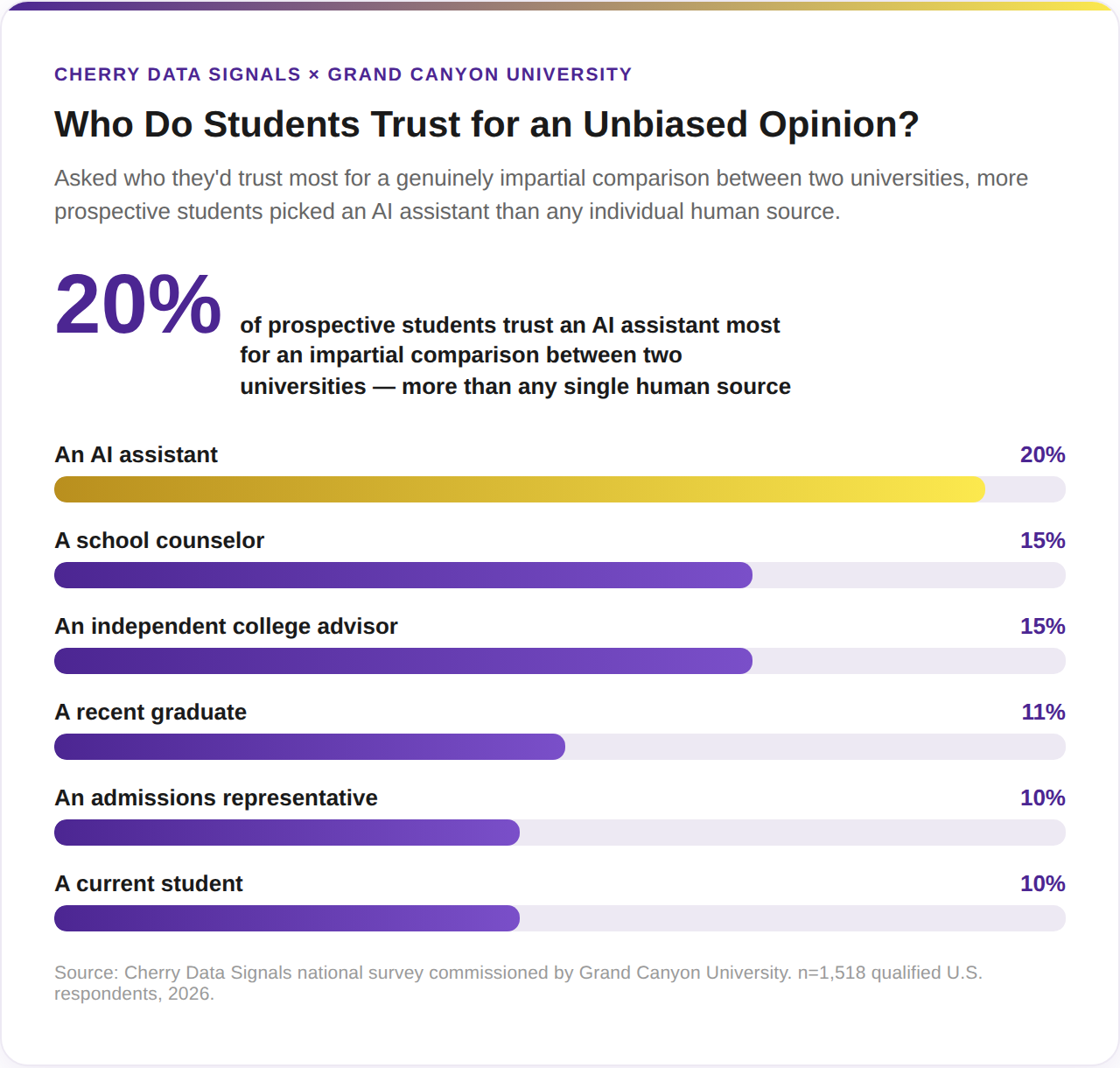
02 / Topic research
Find a question the brand has a reason to answer
Cherry Data Signals came up with the topic through research. The starting territory was the changing college-research journey: where prospective students discover institutions, which sources they believe and what they do when different sources disagree. It was a subject closely connected to GCU’s audience, but broad enough to produce an editorial resource rather than a narrowly promotional article.
From a content strategy perspective, the strongest part of that territory is the relationship between channels. An AI assistant can help build a shortlist. A campus video can change someone’s impression. A Reddit discussion can raise questions about cost or student experience. An official website can be used to check the answer. Looking at one channel in isolation would miss the interaction between discovery, trust and verification.
The published report therefore addresses a recognizable audience problem, not simply a fashionable keyword. It gives readers a way to understand the sources they are already using. For the commissioning brand, that creates a natural connection between the research and the decisions its audience needs to make, without requiring every paragraph to become a sales message.
Terms such as search intent and audience relevance are useful when they describe this work precisely. They are not substitutes for it. We are not claiming a particular keyword-ranking outcome for the project; the defensible point is that the topic connects original research with a clear reader need and a relevant publishing environment.
03 / Questionnaire design
Separate discovery, trust and decisions
We wrote the survey questions to investigate the topic through distinct behaviors and attitudes. The published study covers the use or consideration of AI tools, social-video influence, online communities, information verification and human admissions guidance. These are related subjects, but they do not all measure the same thing.
A source that introduces someone to a university is not necessarily the source they trust most, or the one that has the greatest influence on their final decision. The report keeps those stages separate. That gives the editorial work a more useful structure than a single league table of ‘the most important platforms,’ where different kinds of influence could be collapsed into one misleading answer.
Question wording also sets the boundaries of the claims that can be made later. One headline finding is that 87% of respondents had used an AI tool for their college research or had considered doing so. That is a combined measure of use and consideration. It would be inaccurate to turn it into ‘87% of students already use AI to choose a college.’ The distinction stays important in the headline, body copy and chart explanation.
For a commissioned research asset, this is where editorial planning and research design meet. The questionnaire supplies the evidence; the writing must respect what each question measured. A compelling story is useful only if the underlying claims remain faithful to the responses. The same principle applies to white papers, benchmark reports and other survey-based native content.
04 / Fieldwork and eligibility
Research people with a relevant decision to make
The study reported 1,518 qualified U.S. adults, drawn from 4,275 survey starts. The public methodology describes eligible respondents as current students or people actively considering further education. People who were not students and had no plans to pursue further education were screened out and excluded from the reported figures.
That eligibility distinction is more informative than presenting the total number of starts as the sample. The research was not a general-population poll in which anyone’s opinion about universities counted equally. Its published findings came from people meeting the study’s criteria. The 1,518 qualified completions are the reported sample; the 4,275 starts are part of the recruitment and screening context.
The published methodology describes a geographically representative online panel of double opt-in members, tailored to the eligibility requirements. It also documents digital fingerprinting, bot checks, geographic verification, speeding detection and individual response review, alongside scrutiny of open-ended answers. These are the methods described for the study, not a claim that any survey process eliminates every possible source of error.
A credible research-content asset should make its evidence understandable. Readers need to know who answered, who was excluded and how the responses were handled. Publishing those details makes it easier to assess the findings and use them responsibly. It is also part of the difference between a proprietary research report and an article that presents unsupported percentages without a visible source.
05 / Data analysis
Turn responses into findings worth explaining
Cherry Data Signals handled the data crunching and the work of identifying relationships and correlations. The purpose of analysis was to move beyond a collection of answers and identify an intelligible account of the research journey. We do not name unpublished correlations, statistical tests or subgroup results here: the examples in this case study are drawn from the findings visible in the published report.
One useful analytical distinction is between broad openness to AI and the desire to verify important information. The article reports widespread use or consideration of AI, while also describing the subjects respondents would check elsewhere, including financial aid, tuition, admissions requirements and accreditation. Those findings can sit alongside each other without contradiction. They describe different parts of the same research behavior.
Another distinction is between social influence and institutional confirmation. The published report says 49% of respondents had added or removed a university from consideration because of social media. It also identifies the official university website as the leading verification destination and the largest single reported influence on the final decision. A strong narrative preserves both findings rather than choosing whichever produces the most dramatic headline.
Correlation is not causation, and a survey of reported attitudes and behavior is not an experiment proving that a channel caused an enrollment. That boundary matters in commercial writing. The data can explain what respondents reported and reveal patterns worth discussing; it should not be inflated into proof of revenue, admissions performance or marketing effectiveness that the project did not measure.
06 / Editorial development
Build a story around the evidence, not around a spreadsheet
Our copywriting role was to turn the analysis into a coherent, substantial article. The finished publication moves through AI, social video, Reddit, official websites, admissions guidance and the experience of doing more research. That structure allows readers to follow a decision journey rather than work through disconnected question-by-question results.
The article’s Reddit section illustrates why interpretation matters. Its framing—‘Distrusted as a Source, Relied on for the Truth’—expresses a tension in how people use online communities. The writing explains what respondents seek there, where they place trust and why verification remains important. It is more useful than declaring either that Reddit is universally trusted or that anonymous discussion has no influence.
Each major section also translates the research into practical college-search guidance. That keeps the report relevant to the person reading GCU’s website, rather than making it exclusively a document for marketing professionals. The data supplies the original contribution; the editorial layer helps the audience understand what to do with it.
Native content in this context means content published within the client’s own editorial environment. It is not a claim about paid placements on other publishers’ websites. The GCU project combines research and writing in a format that belongs on its blog. A white paper can use the same research-to-editorial approach, but this particular published deliverable is a web article, not a downloadable white paper.
07 / Data visualization
Make the important distinctions visible
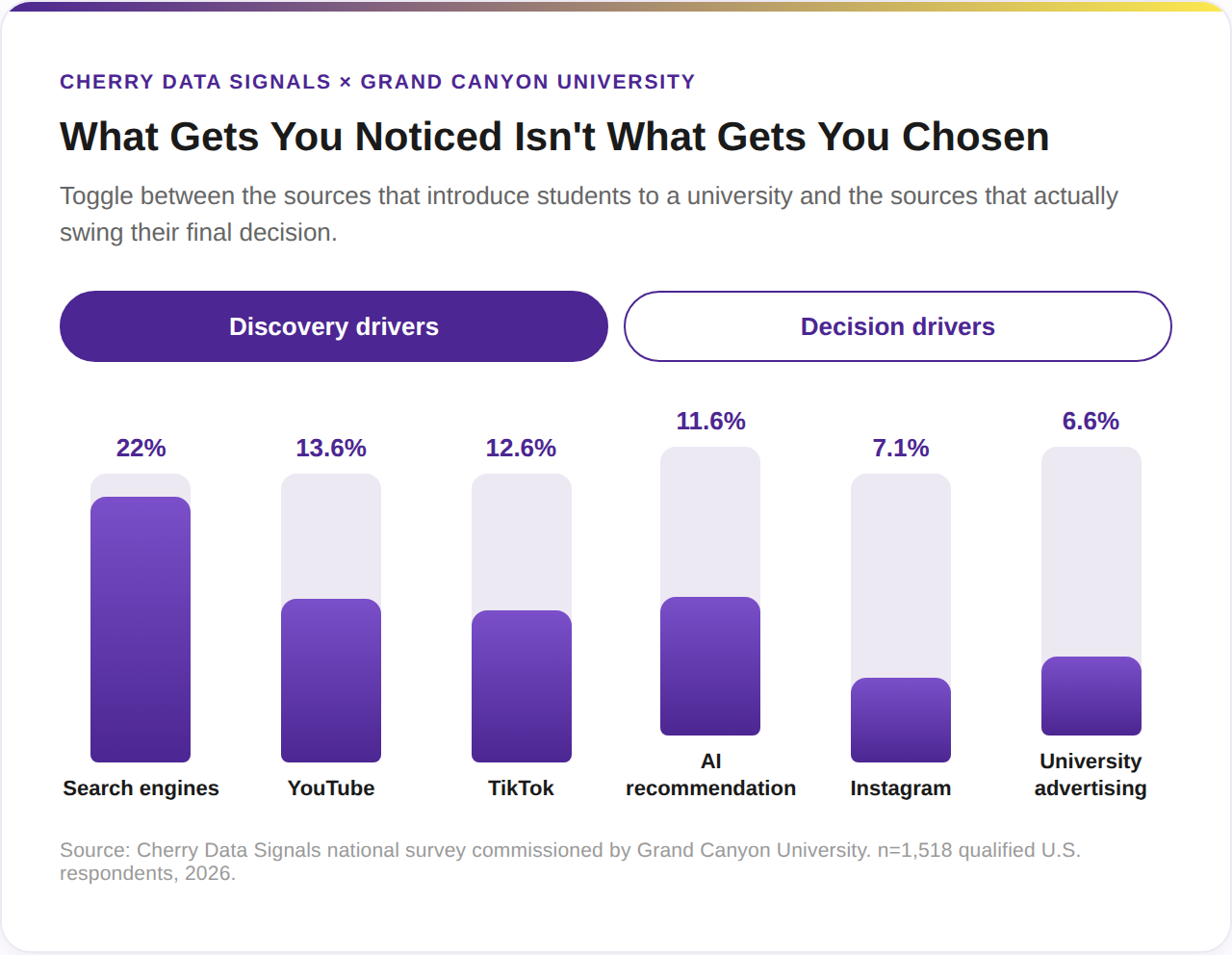
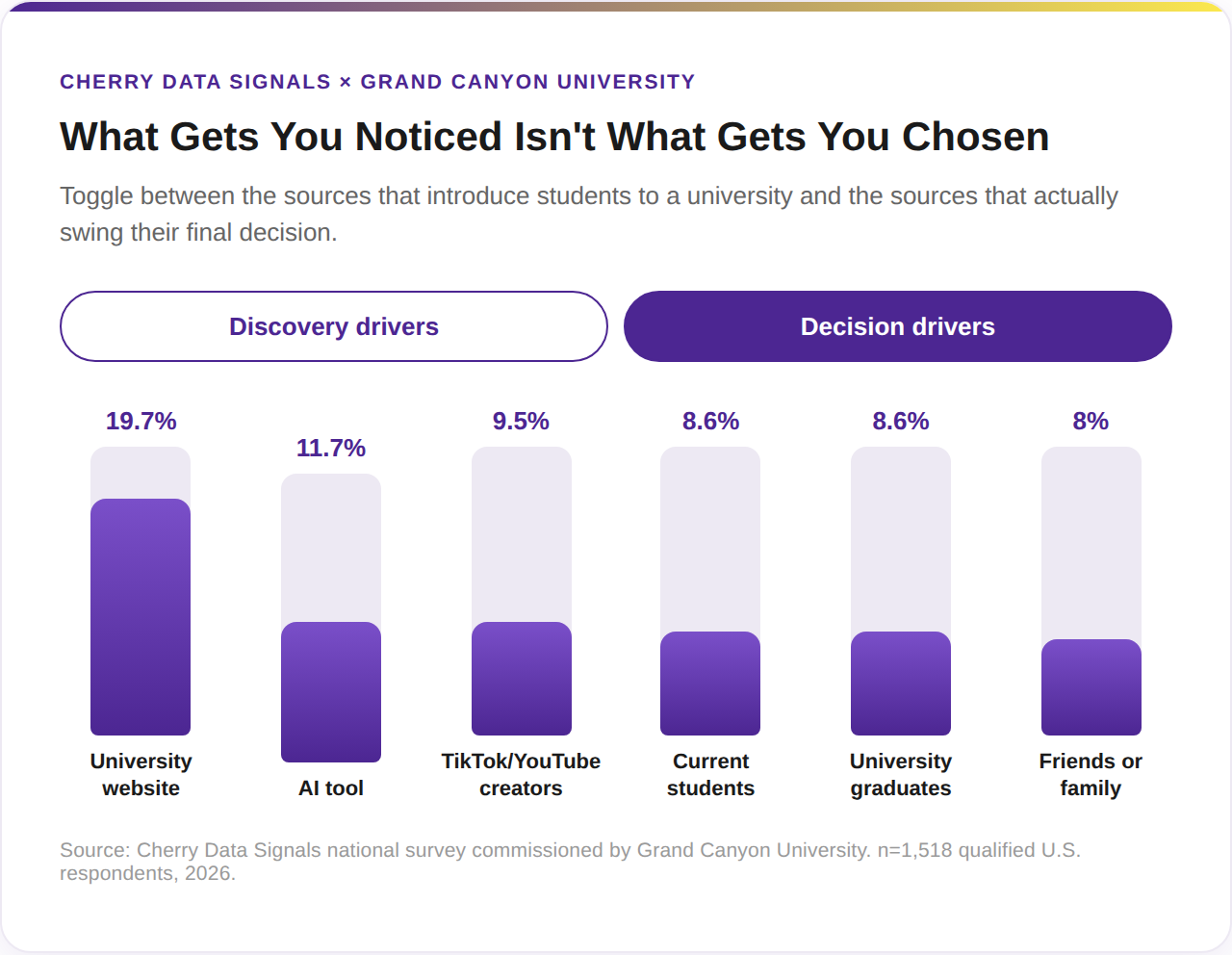
We created charts as part of the project, not as an afterthought to decorate the copy. Data visualization gives readers another way to inspect a finding and compare the sources or behaviors being discussed. The chart assets shown here come from the GCU project; they are not imagined performance results or a recreation of what a future campaign might achieve.
The discovery and decision charts are especially useful together. One concerns which sources introduce people to universities they had not considered; the other concerns the sources with the greatest influence on the final choice. Putting those questions next to each other makes the difference between awareness and decision influence visible without pretending that they are interchangeable metrics.
The writing around a chart remains as important as the image. A useful figure needs a clear question, understandable labels and the right context for its percentages. The public methodology notes that multi-select responses can total more than 100% and that rounding may prevent totals from adding to exactly 100%. Those qualifications belong with the research, not hidden behind a more exciting interpretation.
For a marketing team buying a research-content project, charts are part of the usable asset. They help communicate evidence inside a long-form article and can support further explanation of the same findings. Any reuse still needs the correct source, question context and permissions. The value comes from making the underlying research clearer, not merely making a page look more ‘data-driven.’
08 / Publication
A finished research asset on GCU’s own website
The completed article is publicly available on GCU’s website, under the GCE Editorial Team byline. It includes an executive summary, thematic research sections, charts, a methodology explanation, a practical checklist and frequently asked questions. The publication itself is the concrete outcome shown in this case study.
Publishing original research on a brand’s own domain is different from sending a press release and hoping another publisher writes about it. It creates a destination that the brand can reference directly. Readers can inspect the findings in context, follow the argument and see how the study was conducted without needing to reconstruct the work from a short quotation elsewhere.
The editorial structure also provides multiple entry points. Someone interested in AI can read that section; someone assessing Reddit can find the relevant discussion; someone trying to verify a claim can go to the methodology. This is a practical content-design benefit visible in the finished asset, not evidence of a particular engagement or conversion rate.
We distinguish completion from performance. Publication is verified. Search traffic, rankings, backlinks, AI citations and enrollment-related outcomes would require separate evidence. This case study does not attach invented numbers to them. Its proof is the research, the documented project scope and the finished article that prospective clients can read for themselves.
09 / Search and content strategy
Give your website something original to contribute
From an SEO perspective, original research gives a page something to contribute beyond a summary of other websites. The GCU report contains first-party survey findings about a specific audience and question. ‘Information gain’ is a useful description of that additional evidence; it is not a measured score we are assigning to the page, nor a guarantee that Google will rank it above competing content.
The report also connects several related reader questions within one subject: AI-assisted college research, social-video discovery, online-community trust and official-source verification. That can support a wider content strategy around the college-research journey. It does not establish that GCU gained topical authority or particular rankings as a result; those would be conclusions to test, not assumptions to write into a case study.
Clear, attributable findings may give journalists, other publishers and AI systems a reason to reference the research. The important word is ‘may.’ There is no promise of AI inclusion, no assertion that publishing the article trains an AI model and no special schema requirement being claimed here. Original evidence creates a potential source; actual citation depends on how external systems select and use it.
For prospective clients, the strategic proposition is straightforward: instead of commissioning another article built entirely from existing material, commission research that supplies something new. Pair it with careful interpretation, readable copy, useful charts and transparent methods. That is a stronger basis for a content asset, while leaving search and commercial performance to be assessed with real evidence.
10 / What clients are buying
One connected project, from the research question to the finished content
The GCU project demonstrates the scope of Cherry Data Signals’ Original Research Content service. Topic development, questionnaire writing, fieldwork, data analysis, relationship exploration, copywriting and charts were parts of one connected assignment. The service is not a small editorial add-on attached to a response order; it is the work of creating a substantial, evidence-led asset for a brand.
That connected approach is useful when a team has an important subject to explore but does not want to coordinate research and editorial work separately. It also makes the boundaries of the assignment easier to discuss: the audience, the research question, the evidence required and the format of the finished publication. A native article, a white paper and a benchmark report need different editorial treatments even when each begins with a survey.
GCU is a higher-education example, but the principle is not limited to universities. A travel brand might investigate booking decisions; a financial brand might explore consumer attitudes; a professional-services firm might study changes in its market. Those are possible applications, not additional projects or results claimed here. Each assignment needs its own relevant question and suitable audience.
If your brand needs a survey-led white paper or original research article, the starting conversation is about what your audience needs to understand—not a predetermined statistic we hope to prove. The GCU publication shows what a completed project can look like. Your project should be shaped by your own topic, evidence and publishing goals.
Source and project scope
Study figures and methodological details come from GCU’s published article, dated September 16, 2026. Project responsibilities are described by Cherry Data Signals. This case study was published October 8, 2026.
Next, read how we built a survey-led white paper for AMFM.